Only 5.61% of the Top 10,000 Sites Have an llms.txt
A survey of HTTP Archive data found just 5.61% of the top 10,000 websites have a valid llms.txt file — up more than 5x in a year.
Source caseyrb.com · 2026-06-20 · Checked 2026-09-21
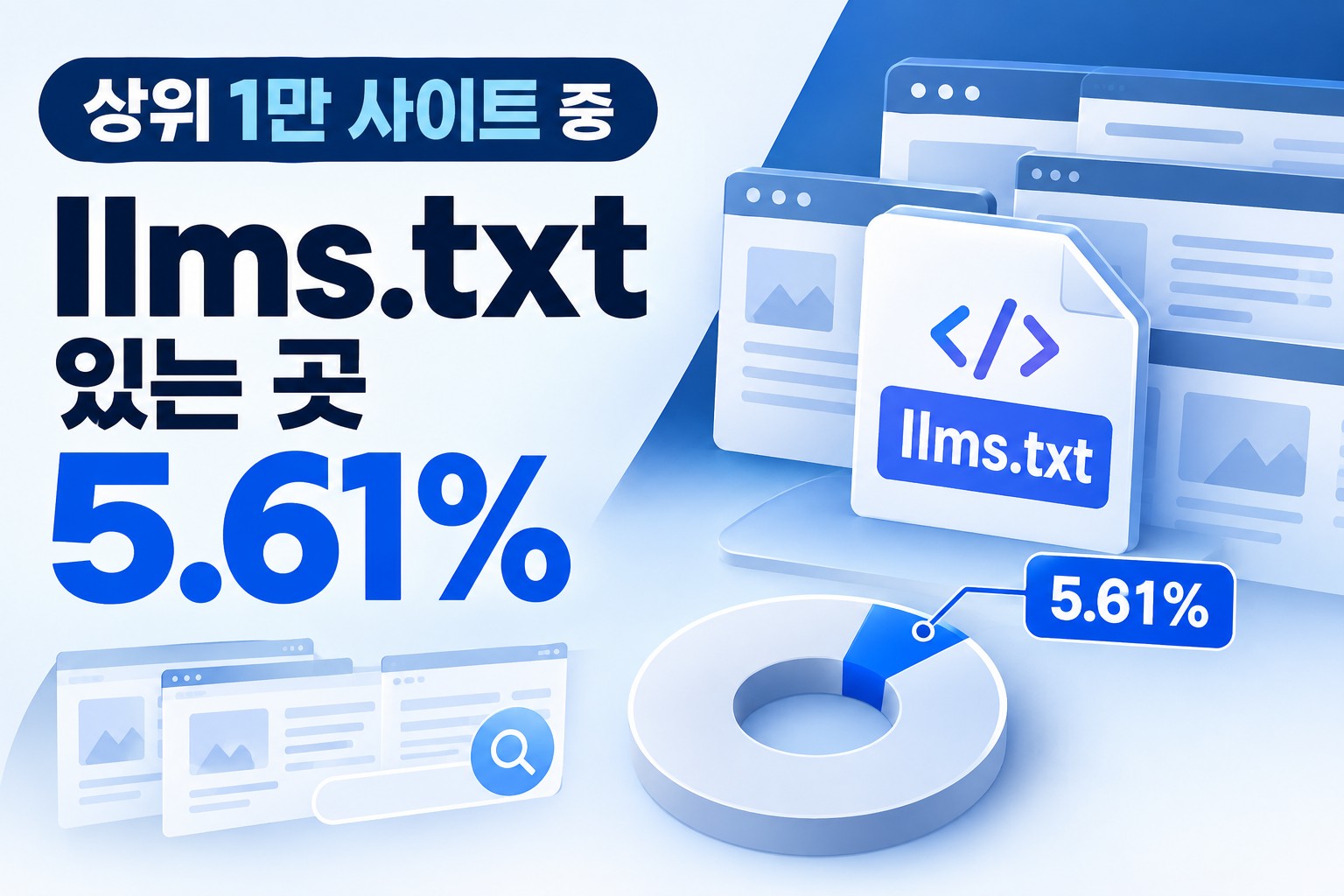
A survey using HTTP Archive's BigQuery dataset set out to measure how widely llms.txt — the file meant to help AI systems read a site's content more easily — has actually been adopted. Published by Casey Burridge on June 20, 2026, the study has tracked monthly data since July 2025, counting only sites that return a genuinely parseable llms.txt rather than an HTML soft-404. It crawled sites with real Chrome traffic rather than random URLs.
As of June 2026, 5.61% of the top 10,000 sites (421 of 7,504 crawled) had a valid llms.txt. Extrapolated to the top 1 million sites, that's roughly 39,000 sites. Adoption grew from 1.04% in July 2025 to 5.61% a year later — about a 5.4x increase, with the pace accelerating in early 2026.
By platform, Shopify led at 78.1%, but the source attributes this to a silent, platform-wide rollout Shopify pushed in April–May 2026 rather than organic adoption by individual merchants. Among CMSs, WordPress sat at 8.7%, Contentful at 22.9%, Adobe Experience Manager at 19%, and Drupal at 1.5%.
Adoption was fairly flat across rank tiers — 6.28% for the top 1,000 sites versus 5.07% for the top 1 million — which the source reads as evidence that llms.txt is spreading broadly rather than concentrating among a handful of large sites. Notably, the consumer-facing sites for ChatGPT, Claude, and Gemini themselves lacked an llms.txt, even though developer documentation sites for companies like Anthropic and xAI had one.
Adoption keeps climbing even as the standard itself keeps changing. According to Refonte Learning, version 2 of the llms.txt spec, released August 10, 2026, added link tags and HTTP headers so sites can point to the file's location, made the markdown filename convention more flexible, and let sites scope a separate llms.txt to individual subdirectories. Google, meanwhile, has been blunt about where it stands: its Search Central guidance says "you do not need special AI markup or an llms.txt file to gain visibility in Google's generative Search," adding that maintaining one "won't harm (nor help) your visibility or rankings in Google Search, as Google Search ignores them." Google points instead to ordinary fundamentals — crawlability, page speed, structured data — as what actually shapes AI visibility.
In Korea
This survey covers sites visible to HTTP Archive worldwide and doesn't break out a Korea-specific number. The fastest way to check any Korean site is to open "/llms.txt" after its domain directly. Keep in mind this survey only measures whether the file exists — whether AI systems actually read and use it is a separate question the data doesn't answer. And since Google itself says it ignores the file, anyone deciding whether to build one is probably better off treating it as a minor addition rather than a substitute for the crawling and markup basics that still matter.
Source: caseyrb.com, Casey Burridge, June 20, 2026. Checked September 21, 2026. Read the original